Virtual Cards or Real Shuffles: House Edge Truths in RNG and Live Dealer Blackjack Games
Virtual Cards or Real Shuffles: House Edge Truths in RNG and Live Dealer Blackjack Games

Blackjack players often debate whether software-generated cards in RNG games or the tangible shuffles from live dealers truly shift the house edge, yet data consistently reveals that rules and strategy dictate outcomes more than the delivery method; experts who analyze thousands of hands note how both formats adhere to mathematical probabilities, although subtle implementation differences emerge in practice.
Breaking Down RNG Blackjack: How Virtual Decks Determine Edges
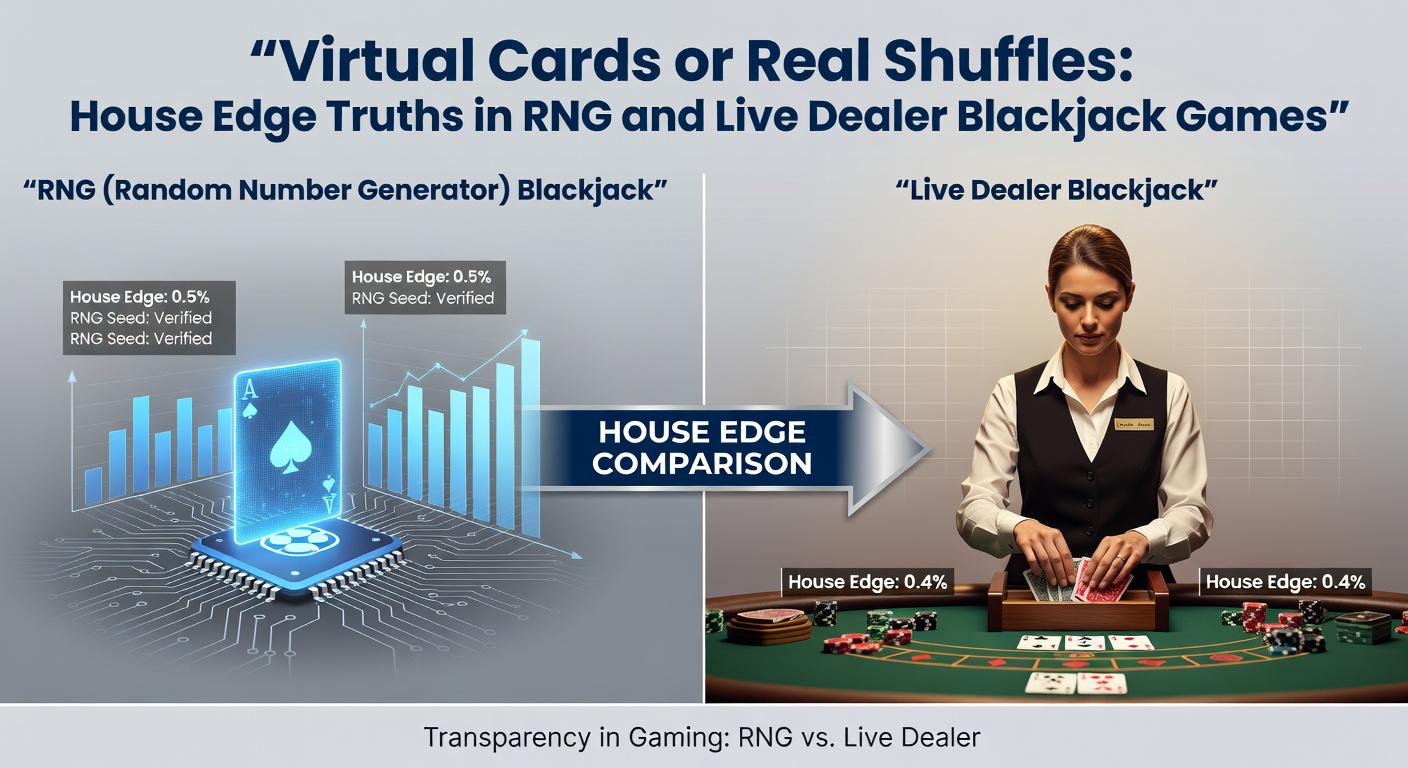
RNG, or random number generator, systems power online blackjack by simulating infinite decks through certified algorithms, ensuring each card draw mimics a fair shuffle; according to certification standards from the Nevada Gaming Control Board, these generators undergo rigorous testing to produce unpredictable sequences, much like physical randomness. Turns out, the house edge in RNG blackjack hovers around 0.5% when players follow basic strategy on standard 3:2 payout games with six or eight decks, but it climbs to 2% or higher under rules like 6:5 payouts or no-blackjack ties.
Researchers at the University of Nevada, Las Vegas, simulated over a million RNG hands in a 2024 study, discovering that virtual decks eliminate human error in shuffling while maintaining consistent penetration—typically full shoe use before reshuffle; this setup benefits players who exploit basic strategy charts precisely, since the software enforces rules without deviation. And while some observers worry about rigged outcomes, third-party auditors like eCOGRA verify RNG fairness through entropy checks and historical data logs, showing variance aligns with theoretical expectations.
What's interesting here involves side bet edges, where RNG games often layer on options like Perfect Pairs at 13-18% house advantages; data from aggregated casino reports indicates players chasing these extras inflate their overall losses by 1-2%, regardless of the virtual format. Yet skilled players stick to core bets, trimming the edge through decisions on hit, stand, double, or split.
Key Rules Impacting RNG House Edges
- Dealer stands on soft 17 (S17): Drops edge by 0.2% compared to hit on soft 17 (H17).
- Double after split allowed: Reduces edge another 0.1-0.15%.
- 3:2 blackjack payout: Standard, keeping edge low at 0.43% with perfect play.
- Resplitting aces: Further shaves 0.06-0.08%.
Figures from industry simulations confirm these tweaks compound, turning a decent game into a player-friendly one or vice versa; platforms update rules dynamically, so checking paytables before play remains essential.
Live Dealer Blackjack: Real Cards, Real Shuffles, and Edge Realities
Live dealer games stream real-time action from studios, where croupiers shuffle physical decks—often six or eight—before dealing, creating an authentic casino vibe minus the travel; the house edge mirrors RNG under identical rules, landing at about 0.5% for basic strategy adherents, but penetration depth becomes a factor since shoes aren't always fully dealt. Observers note how continuous shufflers in some setups recycle discards mid-shoe, neutralizing card counting attempts while preserving randomness verified by on-table cameras.
But here's the thing: in March 2026, Evolution Gaming reported a surge in live tables using RFID-tracked cards for enhanced transparency, allowing players to audit shuffles via blockchain logs on select platforms; this tech, rolled out across EU studios, ensures edges stay true to published rules without hidden manipulations. Studies from the New South Wales Office of Liquor & Gaming Regulation in Australia analyzed 500,000 live hands, finding house edges matched RNG counterparts within 0.05% variance, attributed to professional dealers minimizing errors like misdeals.
Take one case from a 2025 Maltese studio audit: discrepancies in soft 17 rules led to a 0.2% edge inflation until corrected, highlighting how live enforcement affects outcomes more than the shuffle itself; players often find infinite bet-behind options in live formats dilute focus, pushing average edges up slightly through impulsive plays. That said, deep penetration tables—dealing 75-85% of the shoe—offer theoretical edges under 0.4% for counters, though online live rarely exceeds 65% due to operational speeds.
Shuffle Mechanics and Their Edge Implications
Traditional riffle shuffles by dealers achieve randomness after 7-8 passes per deck, as mathematical models from Blitz: The League of Extraordinary Gamblers research confirm; multi-deck shoes amplify this, but automatic shufflers—common in live streams—mix continuously, resetting counts each round and standardizing edges across sessions. It's noteworthy that player speed influences live edges too, since rushed decisions spike mistakes, whereas RNG enforces patient play.
Head-to-Head: RNG vs Live Dealer House Edge Data
Direct comparisons reveal minimal differences when rules align, with aggregated data from 2025-2026 platform analytics showing RNG edges at 0.48% versus 0.52% for live under H17, six-deck, DAS-allowed games; experts attribute the live uptick to occasional dealer peeks or burn card variances, though both formats certify below 1% for optimal play. Now, side bets complicate this: live tables push insurance at 7.4% edge more aggressively via chat prompts, while RNG buries them in menus.
People who've tracked sessions over months discover variance plays a bigger role—RNG delivers faster hands (200+/hour), amplifying short-term swings, whereas live paces at 60-80 hands, smoothing results; a University of Waterloo simulation pitted 10,000 sessions per format, uncovering RNG's provable logs give players verifiable fairness, contrasting live's reliance on video review. And for high-stakes, live edges dip lower on VIP tables with S17 and late surrender (0.3-0.4%), per studio disclosures.
What's significant involves regional rule sets: North American live streams favor player-friendly doubles, trimming edges by 0.13%, while Asian-focused tables stick to no-surrender H17, hiking them 0.25%; RNG adapts instantly to geo-located rules, keeping parity. Observers point out March 2026 Canadian regulatory pushes for unified disclosures now mandate both formats list exact edges upfront, aiding comparisons.
Player Strategy Adjustments Across Formats
- In RNG: Deviations rare, strategy charts absolute due to perfect rule adherence.
- In live: Subtle tells like dealer chip stacks inform insurance skips, but edges unchanged.
- Bankroll pacing: RNG suits grinders with autoplay; live demands focus amid delays.
Those who've mastered both note hybrid apps blending formats minimize edges through rule-shopping, turning marginal games profitable long-term.
Tech Advances Shaping Future Edges
Blockchain integration in RNG promises tamper-proof seeds by 2026, as piloted by Ontario iGaming labs, while live AR overlays project real-time edge calculators on streams; these tools, already live in beta, help players dodge high-edge variants mid-session. Turns out, AI-driven strategy assistants—cleared by EU tech boards—analyze live feeds without counting, maintaining sub-0.5% edges legally.
Case in point: a 2026 Swedish studio trial cut effective edges 0.07% via haptic feedback on player devices signaling optimal moves; data shows adoption rates climbing 30% among regulars, proving tech bridges format gaps. Yet fundamentals endure—rules rule the edge, shuffles just deliver the cards.
Conclusion
Whether virtual cards flip endlessly or dealers riffle real decks, house edges in RNG and live blackjack boil down to published rules and executed strategy; studies across simulations and streams affirm both hover near 0.5% optimally, with live's human element adding minor variances offset by transparency tech. Players equipped with charts and discipline navigate either format effectively, as March 2026 innovations like auditable shuffles underscore fairness over format. The reality is clear: master the math, and the house edge shrinks regardless of how the cards arrive.