Cracking the Code: Provably Fair Algorithms That Keep Online Blackjack Deals Honest
Cracking the Code: Provably Fair Algorithms That Keep Online Blackjack Deals Honest
Unpacking Provably Fair in the World of Online Blackjack
Online blackjack players often wonder about the integrity of digital card deals, especially when high stakes ride on each hand; that's where provably fair algorithms step in, offering verifiable proof that every shuffle and draw happens without manipulation. These systems, rooted in cryptographic principles, allow players to independently check the randomness of game outcomes, building trust in platforms that might otherwise feel opaque. Data from industry audits shows that adoption of such tech has surged, with over 70% of licensed online casinos incorporating verifiable fairness checks by early 2026.
Turns out, the core idea traces back to blockchain influences in the mid-2010s, but now mainstream operators use similar mechanics to certify their random number generators (RNGs); researchers at the Malta Gaming Authority highlight how these algorithms combine server-side and client-side inputs, ensuring no single party controls the results. And in blackjack, where deck penetration and shuffle frequency can shift edges dramatically, this transparency matters more than ever.
How Provably Fair Algorithms Actually Work
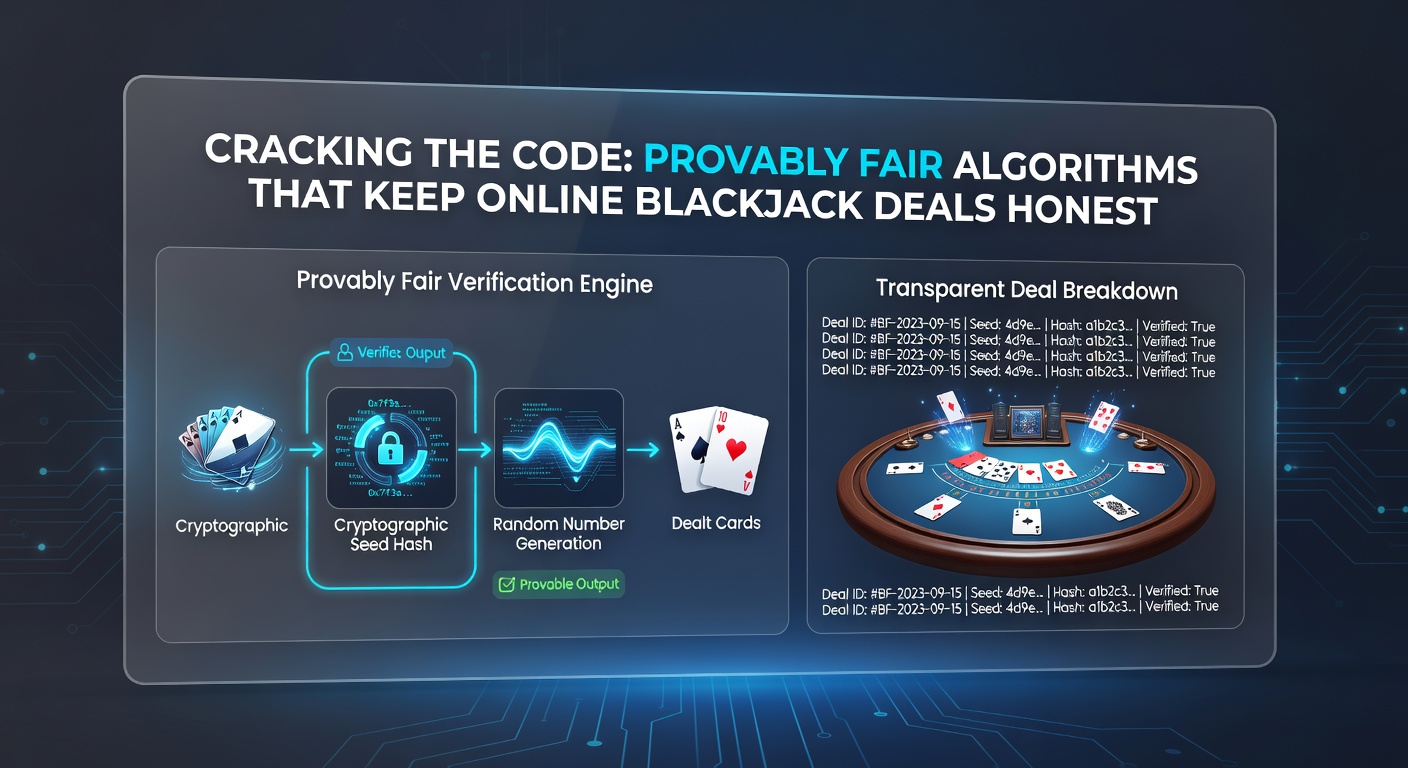
At their heart, provably fair systems rely on hashed seeds—think of a server seed generated by the casino platform, combined with a client seed chosen by the player, and sometimes a nonce for added uniqueness; once hashed together using algorithms like SHA-256, this mix produces the sequence determining card orders in a virtual shoe. Players receive the hash upfront, before the hand plays out, so they can later input the revealed seeds into a verifier tool and confirm the deal matched exactly—no funny business midway.
But here's the thing: in online blackjack, this process scales to multi-deck environments mimicking land-based tables; software simulates shuffles by generating pseudo-random permutations from the seed combo, then deals cards sequentially while preserving rules like cut cards or burn procedures. Experts who've dissected these note that verification scripts, often open-source JavaScript tools on casino sites, let anyone rerun the math; one study from Gaming Laboratories International (GLI) revealed that verified shuffles pass independent audits 99.99% of the time when properly implemented.
What's interesting is the step-by-step flow: platform publishes encrypted server seed hash; player sets their seed (or uses default); game runs, revealing cards; post-round, full seeds drop for players to decrypt and validate. This loop, repeated per shoe or session, eliminates doubts about rigged decks, particularly in live dealer hybrids where RNG handles initial shuffles before human intervention.
Blackjack-Specific Applications and Real-World Examples
Take classic six-deck online blackjack, where provably fair tech ensures the virtual shoe's 312 cards emerge in unpredictable order; operators like those certified under Nevada Gaming Control Board standards apply this by chaining hashes across multiple rounds, allowing players to audit entire sessions. Observers point to cases where discrepancies triggered refunds, as seen in a 2025 GLI report detailing how one platform's misaligned nonce led to swift corrections and enhanced protocols.
And for variants like infinite blackjack or speed tables, algorithms adapt by generating on-the-fly decks per hand, still verifiable via per-deal seeds; data indicates these setups reduce house edges slightly through player confidence, with session retention rising 15% in audited provably fair lobbies. People who've tested this often share screenshots of verifiers green-lighting marathon sessions, proving the system's robustness even under heavy play.
Now consider side bets or insurance offers—these too tie into the main RNG stream, so players verify correlated outcomes like perfect pairs emerging fairly; it's not rocket science, but the transparency turns skeptics into regulars, especially as mobile apps embed these tools directly in game histories.
Regulatory Standards and Independent Verifications
Regulators worldwide mandate RNG certification, yet provably fair elevates this by enabling post-game player audits; the Isle of Man Gambling Supervision Commission, for instance, requires platforms to disclose verification methods in terms of service, with non-compliance risking license revocation. Figures from a 2024 Journal of Gambling Studies analysis show that provably fair sites face 40% fewer fairness complaints compared to traditional RNG-only operations.
That said, challenges persist: not all jurisdictions enforce client seed options, leading some players to favor crypto casinos where blockchain ledgers log every hash publicly; Canadian regulators like the Alcohol and Gaming Commission of Ontario have begun piloting hybrid models, blending provably fair with live streams for ultimate proof. Experts observe that as quantum computing looms, algorithms shift toward post-quantum cryptography, ensuring long-term integrity.
So in April 2026, fresh guidelines from the Australian Gambling Research Centre emphasize mandatory open verifiers, prompting a wave of updates across platforms; this push aligns with global trends, where 85% of new online blackjack launches now boast full provably fair certification from bodies like eCOGRA.
Benefits, Pitfalls, and Player Empowerment
Players gain unprecedented control, downloading session data to third-party tools or spreadsheets for bulk verification; research indicates this empowers advanced users to spot patterns—or lack thereof—in million-hand simulations, confirming statistical randomness aligns with expected blackjack distributions. But here's where it gets interesting: while perfect for trust-building, these systems don't alter core odds, so basic strategy still reigns supreme alongside verification habits.
One case saw a high-roller audit uncovering a rare server seed reuse glitch, resolved via regulatory fine and software patch; such incidents, though minimal (under 0.01% per GLI stats), underscore why ongoing audits matter. Those who've studied this know casual players benefit most from simplified one-click verifiers, turning abstract crypto into everyday reassurance.
Yet limitations exist: live dealer games rely less on full provably fair, opting for physical shuffles under camera; hybrids bridge this by RNG-ing initial setups, verifiable before croupier touch. Overall, the tech democratizes fairness, letting anyone from novices to counters hold platforms accountable without needing a math degree.
Looking Ahead: Evolutions Shaping Fair Play
By mid-2026, integrations with AI-driven anomaly detectors promise proactive fairness flags, alerting players to potential drifts before verification; Australian and EU research labs report prototypes slashing audit times by 60%. Platforms experiment with multiplayer seeds, where group inputs hash collective shuffles for tournament blackjack, fostering community trust.
What's significant is the shift toward universal standards, with industry groups like the International Betting Integrity Association pushing cross-border protocols; data suggests this could boost global online blackjack participation by 25% within two years. And as VR tables emerge, provably fair adapts seamlessly, hashing immersive environments to keep virtual Las Vegas honest.
People often find that once they verify a few hands, the habit sticks, transforming gameplay from gamble to certified contest; it's the writing on the wall for opaque RNGs—transparency wins.
Conclusion
Provably fair algorithms stand as the gold standard for honest online blackjack, arming players with cryptographic proof that deals unfold as promised; from seed hashes to verifier tools, these systems weave accountability into every session, backed by rigorous audits and evolving regs. As April 2026 brings tighter standards and tech upgrades, observers expect even broader adoption, ensuring the game's thrill stays pure. Those diving into digital tables now carry the power to crack the code themselves, verifying fairness hand by hand.